
Everything You Need to Know About Dry Needling
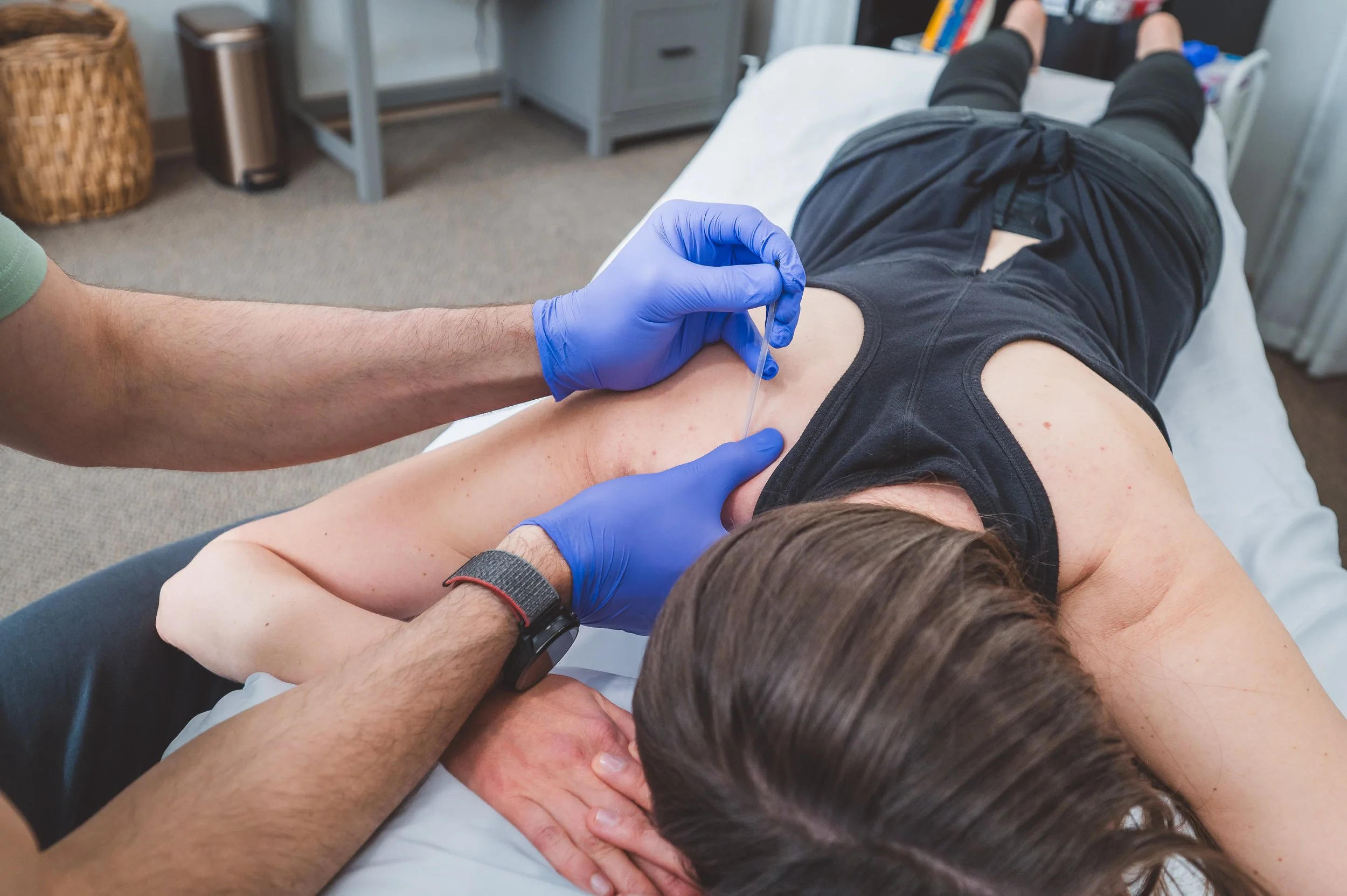
Dry needling is a technique that uses fine-gauge needles to affect muscle, connective tissue, and the nervous system from the needle insertion alone (not injecting anything into the body or taking it out of the body.) As part of a comprehensive plan of care, it is a safe and effective treatment modality that has minimal potential side effects. Dry needling can be used throughout the body for a variety of conditions including pelvic floor symptoms.
Introduction to Dry Needling
Have you ever woken up with that achy knot in your neck or had a charley horse in your leg that just doesn’t seem to go away? Maybe you’ve got chronic pelvic pain that isn’t responding to other treatments or your c-section scar still feels off long after your birth. Perhaps you don’t have pain but no matter what you do, you seem to have imbalances in your training or feel like you just can’t activate your muscles the way you think you should be able to. These are some familiar clinical scenarios in which we have successfully used Dry Needling (AKA Trigger Point Dry Needling or Myofascial Dry Needling) to help people resolve their pain and get back to functioning with ease. While it is just one of many tools we have as physical therapists, it can be highly effective at normalizing muscle and connective tissue so that you feel better and your body can move with more ease.
What is Dry Needling?
Dry needling utilizes very fine gauge needles which are inserted into muscles or connective tissue that is holding tension or otherwise not working well. It helps with mobility, pain, and good activation. It is called “dry” needling because nothing is injected into the body or taken out of the body. Instead, it is the action of the needle itself that does the work. You can think of it as a “reset” for the muscle.
There are different ways to perform dry needling, and for therapists trained in multiple styles, how it is performed can depend on the specific treatment goals, patient preference, and/or how dry needling is being integrated in the rest of a session. Here are a few examples of how it can be applied:
A needle can be inserted directly into a trigger point or “knot” in the muscle. The therapist may move the needle up and down a few times to redirect the needle into different muscle fibers and then immediately take the needle back out. This can be done with one needle insertion or may be repeated in several places.
A needle or needles may be placed in the target tissue and left in place for a period of time.
A needle or needles may be placed in the area being treated and then electrical stimulation can be applied through the needles into the tissue (intra-muscular electrical stimulation). This is then left in place for a period of time.
Dry needling is almost never used as a standalone intervention. While it helps get a muscle or area back to a good starting point, it is important to also address what made that area dysfunctional in the first place. Therefore, incorporating manual therapy, mobility work, stretches, exercises, or movement retraining as part of a comprehensive plan of care is important to help your issue go away and stay away.
Is Dry Needling the Same as Acupuncture?
Dry needling and acupuncture are very different treatments. While both use the same needle type, the application and purpose are distinct. Dry needling comes from a Western medicine background and philosophy rooted in the musculoskeletal and nervous systems. Acupuncture comes from an Eastern medicine background and is rooted more in energy work. Because of these differences, each one has different techniques, approaches, and intentions. Both can be of great benefit depending on your needs and desires, but they are not the same.
Is Dry Needling New?
It may seem like there is a lot of new buzz around dry needling or it is just coming on the scene, but in reality it has been around a long time! The origin of dry needling can be traced back to the 1940s and the modern day practice of dry needling began in the 1970s. This is extremely helpful because it also means we have a lot of research to back up its use and support the safety and efficacy of the technique.
So why haven’t you heard about it until now? Different states have different physical therapy practice acts and a dry needling endorsement only became available in Washington state in 2024. While the process is thorough, you can rest assured that providers who hold their dry needling endorsement are more than qualified to provide the service because in addition to holding a doctorate of physical therapy, you have to have been a practicing therapist for at least a year and then additionally complete at least 325 hours of educational and clinical practice specifically in dry needling.
Is Dry Needling painful?
Generally, no! Sometimes you experience a twitch and then a deep, achy, cramping sensation until the muscle relaxes. The muscle treated may also feel sore after dry needling as if you worked out really hard, but this usually only lasts for 24 hours or less. On the flip side, many people have no bothersome symptoms at all. Either way, the relief from the symptom we are trying to treat can be almost immediate and usually outweighs any temporary discomfort.
What Can be Treated with Dry Needling?
Dry needling can have benefits throughout the body and can be literally applied from head to toe. Structures ranging from muscle tissue, connective tissue, scar tissue, and the nervous system can all be targeted depending on the goals of treatment. Here are a few things that can commonly be treated with dry needling, but the list goes on!
Headaches
TMJ symptoms
Neck pain
Shoulder, elbow, or wrist symptoms
Back pain
Hip, knee, or foot pain
Scar restrictions throughout the body
Abdominal pain or dysfunction
Pelvic pain
Tailbone or coccyx pain
Can Dry Needling be Used on the Pelvic Floor?
It is possible and highly effective to utilize dry needling for pelvic floor issues. With specialized training, dry needling can be used directly on the pelvic floor muscles to decrease tension and improve activation. When treating these muscles, they are approached externally and with much less discomfort than many people anticipate. However, pelvic floor issues can also very often be improved by addressing surrounding structures and muscle groups that are related to the pelvic floor including the low back, hips/glutes, inner thighs, and so on. Additionally, dry needling focused more on the nervous system can also have a positive impact on pelvic floor function. Long story short, we can treat the pelvic floor directly with dry needling, but also believe that for best results, we need to be assessing and treating with a whole-body approach so that we can get to the root cause of your issue no matter where it is.
Dry Needling In Richland, WA
If you are located in Tri-Cities, WA, we have multiple clinicians who are endorsed to practice dry needling at our clinic and are accepting new patients. Our therapists all started with a deep foundation in orthopedic physical therapy in addition to specializing in pelvic floor therapy, so whether you have pesky muscle knots that just won’t go away, orthopedic concerns, or pelvic floor issues, we’d be happy to help so that you can take your life back! Learn more or contact us to get started on your path to relief!